
Chatsworth House Library (2023)
Judging books by their covers
Within Chatsworth House there exists a repository of books that would make a collector burn with envy, and prompt an avid reader to think; ‘what a waste’. I found myself among the latter as I wandered through an ocean of books, struggling to see beyond the metal rods imprisoning them on each shelf. These books, written for the eager minds of enthusiasts, had been relegated to a collection of untouchable ornaments and decorative pieces. It brought to mind a quote I had read:
تعلّموا العلم واعقلوه، وانتفعوا به، ولا تعلَّموا لتتجملوا به، فإنه يوشك إن طال بكم عمر أن يُتجمل بالعلم كما يتجمل الرجل ببزّته
“Learn knowledge, understand it and live by it, and do not study it in order to decorate yourself with it for indeed, it is imminent – should your life-spans be prolonged for you – that knowledge will be used as a means for adorning oneself, just as a man adorns himself with his garment.”
– Habib ibn Ubayd
Just as these books have become decoration pieces over time, we should beware of treating the knowledge we gain as a mere adornment, aiming to temporarily impress without yielding or providing any substantial benefit to ourselves or others.
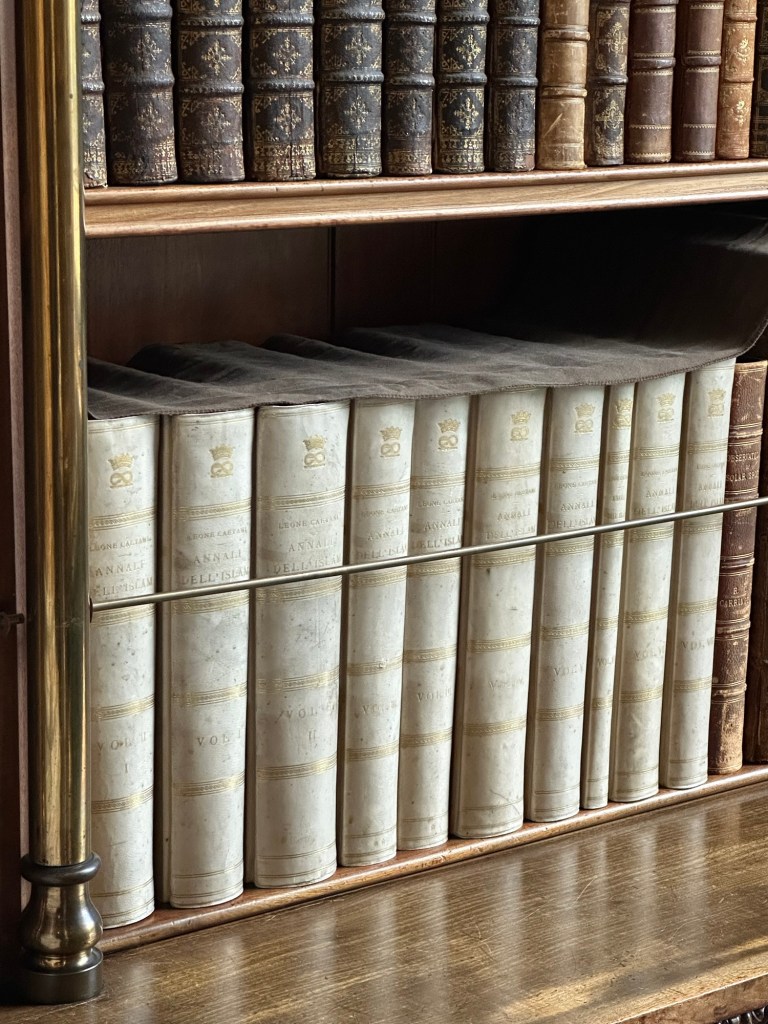
Regardless, I managed to suppress these thoughts and began to marvel at the tapestry of intricately bound knowledge before me. Initially drawn to the names and titles etched into their fragile spines, my focus shifted as I turned towards one particular bookshelf, the top of which kissed the high ceilings of the house, and my superficial nature kicked in as my attention was caught by the external allure of one particular, voluminous book which was almost glowing in the presence of its more tarnished neighbours. I couldn’t quite read the title of it, nor was I trying to, as I was too busy appreciating the beauty of its covers which looked as though they were carved from bone. When I captured the picture below, I did so purely for aesthetic reasons, but when I zoomed in to show my wife, I saw the words “Annali dell’Islam”. I almost felt a sense of pride at the fact that the most beautifully bound book in this treasury bore the name of al-Islam, but little did I know that the aged pages of this book did not mirror its external beauty, and that the author’s journey ‘into’ Islam stood in stark contrast to the expected course of submission and acceptance.
The Curious Prince
To understand the significance of “Annali dell’ Islam,” we must first acquaint ourselves with the intriguing personality of its author.
Leone Caetani, better known as Prince Caetani, was an Italian nobleman born in 1856, who transcended the bounds of his aristocratic lineage and instead dedicated a significant portion of his life to the study of Islamic theology and history.
His pursuit of knowledge led him to a profound understanding of the Arabic language (alongside 11 other languages), Hadith, and the intricate web of other Islamic sciences. However, the issue was not his ignorance of Islam, but his stubborn opposition; this was a man who relinquished his comfortable life as an Italian noble to travel the Islamic world and learn about the religion of its followers, yet remained staunchly resistant to its fundamental message. Caetani wielded what he had learned as a tool to oppose Islam, rather than a key to unlock his hardened heart.
Caetani’s Amazement at the Spread of Islam
For those who examine Islam objectively, whether as historians, academics or otherwise, one question often emerges: ‘how did a small group of followers, in a barren and politically fragmented land, transform into a force that shaped civilisations across continents in such a short period of time?’
The answer for us as Muslims lies in the very essence of Islam’s message: it is a divine revelation from Allah, spread by the Will of Allah.
Caetani hinted towards the ‘miraculous’ spread of Islam, as well as the purity of its core message when he said:
“For the East, with its love of clear and simple concepts, Hellenic culture was, from the religious point of view, a misfortune, because it changed the sublime and simple teachings of Christ into a creed bristling with incomprehensible dogmas, full of doubts and uncertainties; these ended with producing a feeling of deep dismay and shook the very foundations of religious belief; so that when at last there appeared, coming out suddenly from the desert, the news of the new revelation, this bastard oriental Christianity, torn asunder by internal discords, wavering in its fundamental dogmas, dismaved by such incertitudes, could no longer resist the temptations of a new faith, which swept away at one single stroke all miserable doubts, and offered, along with simple, clear and undisputed doctrines, great material advantages also. The East then abandoned Christ and threw itself into the arms of the Prophet of Arabia.”
[Annali Dell’Islam, 2/1045-6]
The likes of Caetani marveled at Islam’s rapid expansion, yet failed to accept its divine origin simply because of their deep-rooted loyalty to Christianity, a faith they themselves admitted was fading away. This brings to light an interesting dynamic: even the most profound recognition of Islam’s impact, based upon knowledge, does not necessarily lead to belief. A prime example that comes to mind for many Muslims is that of Abu Talib, the Prophet’s ﷺ uncle. Before his passing, he had come to acknowledge Islam as the truth, yet he never openly declared his faith and ended up dying as a disbeliever, as he was also held back by his blind attachment to the false religion of his ancestors.
Reflecting upon journeys like Caetani’s prompts contemplation on the principle echoed throughout the Quran:
إِنَّكَ لَا تَهْدِي مَنْ أَحْبَبْتَ وَلَٰكِنَّ اللَّهَ يَهْدِي مَن يَشَاءُ وَهُوَ أَعْلَمُ بِالْمُهْتَدِينَ Indeed, you do not guide whom you like, but Allah guides whom He wills. [Surat al-Qasas, 28:56).
In Caetani, we have the example of a man who looked deeply into the message of Islam and gained an insight into the most intricate of its sciences, yet remained opposed to its message, whilst on the other hand we have examples like that of Jubayr ibn Mut’im, the man who sent Wahshī to kill Hamza رضي الله عنه, the beloved uncle of the Prophet ﷺ. Jubayr was the mastermind behind an action which caused the Prophet ﷺ unimaginable grief, yet when he went to the Prophet ﷺ a few years later to ransom some of the captured idolators, he narrated that he heard the Prophet ﷺ reciting Surat al-Tur in the evening prayer and when he ﷺ reached the verse:
أَمْ خُلِقُوا مِنْ غَيْرِ شَيْءٍ أَمْ هُمُ الْخَالِقُونَ
أَمْ خَلَقُوا السَّمَاوَاتِ وَالْأَرْضَ بَل لَّا يُوقِنُونَ
“Were they created by nothing, or were they creators of themselves? Did they create the heavens and the earth? Rather, they are not certain!” [Surat at-Tūr, 52:35-36]
he said: “I felt my heart was about to fly.” This goes to show that guidance is ultimately a matter of the heart, and while historical facts and intellectual inquiry can bring someone close to the truth, true belief requires an inner conviction granted only by Allah.
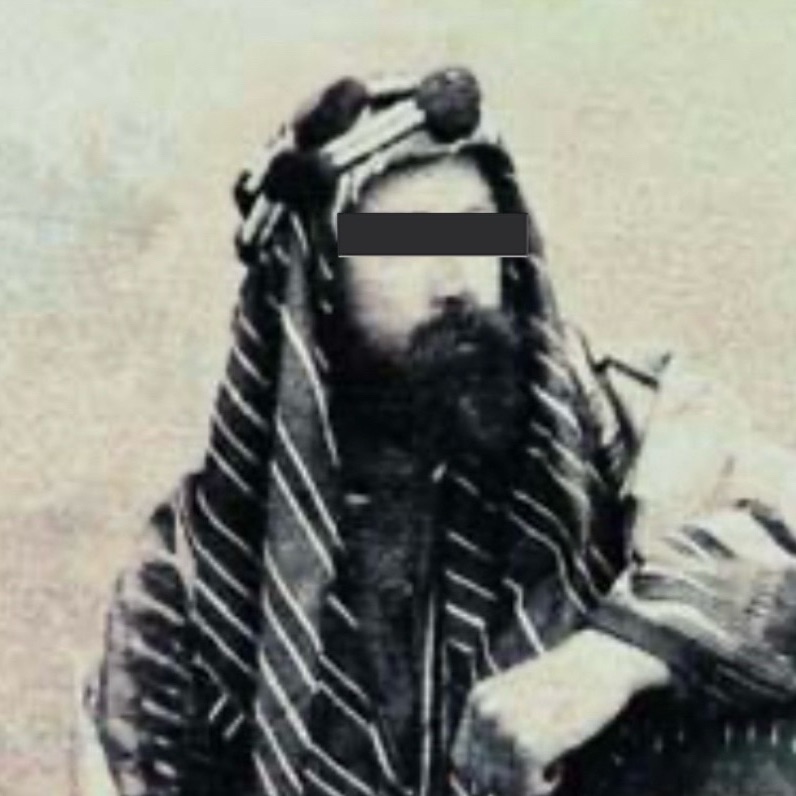
Not only did Caetani fail to accept Islam, he also remained firm upon his enmity towards the religion as is evident in his authored works, and this obstinate determination to vilify Islam ultimately led to his blindness towards the truth.
As Allah told us in the Qur’an:
خَتَمَ اللَّهُ عَلَىٰ قُلُوبِهِمْ وَعَلَىٰ سَمْعِهِمْ وَعَلَىٰ أَبْصَارِهِمْ غِشَاوَةٌ وَلَهُمْ عَذَابٌ عَظِيمٌ
“Allah has set a seal on their hearts and on their hearings, and on their eyes there is a covering. Theirs will be a great torment.” [Surat al-Baqarah, 2:7]
This Ayah gives us a profound insight into why the prince’s heart was so opposed to accepting the truth. Allah places a seal upon the hearts of those who disbelieve and He alone opens it for whom He wills, but if it stays closed, Allah will prevent them from comprehending and seeing the truth even if it is placed right in front of them.
And in the Ayah before it, Allah explains the result of this seal when He Said:
إِنَّ الَّذِينَ كَفَرُوا سَوَاءُ عَلَيْهِمْ أَأَنذَرْتَهُمْ أَمْ لَمْ تُنذِرْهُمْ لَا يُؤْمِنُونَ
“Indeed, those who disbelieve – it is all the same for them whether you warn them or do not warn them – they will not believe.” [Surat al-Baqarah, 2:6]
The Magnum Opus
“Annali dell’ Islam,” (Annals of Islam) stands as a testament to Caetani’s meticulous research and commitment to understanding the intricacies of Islam. The book served as a scholarly entry point to Islam for a western audience at a time when tensions were rising between the Ottomans and the Europeans. The Cretan revolt, in which the Greek insurrectionistss received financial and military support from Caetani’s fellow countrymen against the Ottomans, and the Italo-Turkish war both took place during Caetani’s authorship of this work, which may have further influenced his hostility towards Islam and the Muslims.
Although his conclusions are ultimately tainted with anti-Islamic bias and weak criticisms, there is no doubt that academically speaking, from the translated excerpts I have come across, Caetani was a knowledgeable opposer deeply immersed in his subject matter, yet his knowledge proved fruitless. As Shaykh al-Islām Ibn Taymiyyah once said about the people of innovation:
أوتوا علومًا ولم يؤتوا فهومًا وأوتوا ذكاءً ولم يؤتوا زكاءً
“They were given knowledge but not understanding, and they were given intelligence but not purity.”
Likewise, the prince’s years of study failed to touch his heart, as the gates of true understanding and inner purity remained closed to him.
He who is resistant to change…
There is a famous saying amongst the Italians;
Chi resiste al cambiamento è destinato a perire
“He who is resistant to change is destined to perish.”
This saying echoes the inevitable reality of transformation; those who refuse to adapt, ultimately stagnate, especially when they refuse to adapt to the truth. Caetani, despite his deep research into Islam, exemplified this resistance. He spent the best years of his life studying the religion, exploring its depths with a drive that few could match, yet he remained unmoved by the weight of its truth.
As Muslims, we believe that Allah guides whom He wills, and that true understanding of the religion is not merely an academic pursuit, but a priceless gift from Allah, only given to those sincere seekers of truth who have attained His pleasure. As for those who resist the truth and refuse to change their ways, the Italians would say, ‘è destinato a perire.’
The Lessons of Chatsworth House
As I reflect on Caetani’s work which sits within the weathered walls of Chatsworth House, I’m reminded that knowledge, while a powerful tool, is not a guarantor of enlightenment and success. As the Prophet ﷺ told us:
مَنْ يُرِدْ اللهَ بِهِ خَيْرًا يُفَقِّهْهُ فِي الدِّينِ
“For whomever Allah wills goodness, He grants him understanding of the religion.” [Sahih al-Bukhari, no.71]
Stories like that of our Italian prince show that authentic and beneficial knowledge only leads to true happiness, when one yearns to understand their Creator, submits to Him with a complete submission, and constantly asks Him to replenish the Īmān (faith) and Ikhlās (sincerity) in their hearts.
True beneficial knowledge directs individuals to first and foremost believe in the Tawhid (oneness) of Allah, and then honor His sanctities. It guides them to follow Allah’s commands, and urges them to refrain from His prohibitions. Therefore, someone who gains insight into religion in this manner, with this intention, is the true recipient of Allah’s goodness.
On the other hand, those deprived of these blessings fall into stubborn opposition and negligence, rejecting the truth even when it is placed in their hands. They belong to a category of people whom Allah has not intended to bestow goodness upon, rather He only intends to increase them in humiliation and punishment for their heedlessness and denial. In addition to this, Allah discusses the state of the disbelievers who deviate from the purpose of their creation; emphasising that, as Muslims, it is our responsibility to properly seek understanding of our religion with the correct intention of gaining closeness to Allah.
Allah (سبحانه وتعالى) said:
وَالَّذِينَ كَفَرُوا عَمَّا أُنذِرُوا مُعْرِضُونَ
“But those who disbelieve turn away from that whereof they are warned.” [Surah Al-Ahqaf, 46: 3]
Allah (سبحانه وتعالى) also says:
وَمَنْ أَظْلَمُ مِمَّن ذُكِّرَ بِآيَاتِ رَبِّهِ فَأَعْرَضَ عَنْهَا وَنَسِيَ مَا قَدَّمَتْ يَدَاهُ
“And who does more wrong than he who is reminded of the Ayât (proofs, evidence, verses, lessons, signs, revelations, etc.) of his Lord, but turns away from them, forgetting what (deeds) his hands have sent forth.” [Surah Al-Kahf, 18:57]
What excuse can this curious Italian prince possibly have before His Creator on the Day when no excuses will avail the disbelievers? A man who travelled from Turkey to Tunisia, from Egypt to India and everywhere in between in pursuit of Islamic knowledge, yet his stubbornness and ill intent towards the essence of that which he sought, caused him to overlook and reject the truth that was placed in front of him. May Allah guide us all and keep us firm upon the truth that we seek.
A a person can traverse the globe seeking Islamic knowledge, yet Allah may keep their heart veiled from the truth, and increase them in misguidance. On the other hand, someone with no intention of delving into Islam may find their heart opened by a single word or action. Take the example of ‘Umar ibn al-Khattab, who initially set out to spill the blood of the most beloved person to Allah, and the greatest man to ever walk this earth ﷺ but instead of commiting this atrocious act he ended up, not only accepting Islam, but being from those elite few who were promised Jannah in their lifetime. To an outsider, this may seem unfair or even unjust وأعوذ بالله من ذالك, but our belief in Qadr (predestination) teaches us that Allah is العليم (The All Knowing), knowing the past, present, future, and all possibilities. He is also الحكيم (The Most Wise). His Wisdom, illustrated in the story of al-Khidr and Mūsā عليهم السلام transcends our understanding, and our limited intellects cannot possibly fathom the Will of Allah.
In conclusion, this exploration into Caetani’s remarkable yet terrifying life story serves as a reminder that the path to the truth is one that leads to Allah, so only Allah can guide us to it. No matter how knowledgeable we become, we must remember to implore Allah and continuously ask for His guidance, and should try our best not to become complacent because we have studied a few books and understood a few religious issues. As Imam Ahmad said:
“أصل العلم خشية الله تعالى”
“The foundation of knowledge is the fear of Allah, the Most High.”
[Ṭabaqāt al-Ḥanābilah (283/1)]
The outwardly beautiful set of books which caught my attention that day have become a beacon, reminding me on my own journey of seeking Islamic knowledge, that no matter how many books I may read or how many scholars I may sit with; just like Caetani, I too am walking between the unseen fibres connecting knowledge and faith, and those books serve as a reminder that true guidance transcends the intellectual realm and calls for sincerity and humility before Allah alone.
اللهم إنا نسألك العلم النافعا
اللهم يا مقلب القلوب ثبت قلوبنا على دينك
 Stranger Thoughts // أفكار غريبة
Leave a comment